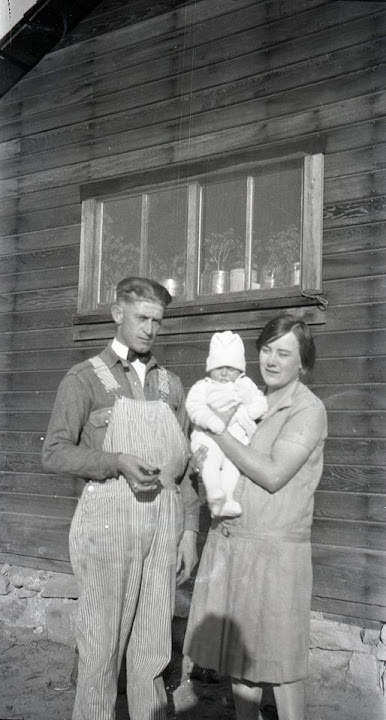
Bill Bates, born of James Ragan and Victoria Bates was the youngest of four children; Luther, Tom, Alma and William. Bill was born on the banks of Cow Creek in Riddle, Oregon; his family were agricultural people growing their own produce and raising their own meat. They probably had an orchard that helped raise income for the family. When Bill was about eleven years old he took ill on a Sunday morning. He went to church with the family and as the service progressed he felt worse. When the family came out of the chapel Bill had some difficulty walking and finally took a fall. He got up and fell down again. His father picked him up and carried him home but refused to call the doctor. James Regan’s family had all died of the fever so it’s easy to understand why he figured his son wouldn’t live through whatever he had. Bill had come down with polio and a fever that left him paralyzed from the neck down. It was one of the first recorded cases in the area. Willie said "when I laid down the corn in the garden was just breaking through the ground and when I looked out again the corn crop had matured and been harvested.” His mother, Victoria who was a midwife and a nurse, took care of Bill but also consulted with a doctor from Portland. Bill was the only person in Riddle to catch the disease. As a result of the disease he laid in bed and couldn't walk for two years. He could swallow but couldn't move. His legs were drawn up against his chest. Their doctor from Portland wanted to cut the cords in his legs to let them down in a more normal position for comfort. Once the cords were cut it was a foregone conclusion that he would never walk again so his mother said NO! Victoria patiently nursed him back to health by applying moist heat and moving his limbs several times a day. It is due to her loving care that Bill regained his health and the use of his limbs. Bill came to Price, Utah as a young man looking for work. He found employment with the Utah Railway where he worked most of his adult life. He married Ida Lucille Richardson and they are the parents of four children. Bill was a kind, gentle man and liked by all who knew him. His pet moniker for Ida was Sally. Bill was an alcoholic and it did cause problems within the family but he was loved very much despite his weakness. His son Jim would often boast of his father’s strength. He loved telling stories of the times his father “street fought” which was like a boxing match out on the street in the coal camps. Bill died at the age of 60 leaving his sweet Ida a widow for 38 years. One day when Annie Jensen’s mother called her “Sally” Ida said, “Bill used to call me that.” Kelley asked grandma if she still missed him. Ida said, “You never stop missing someone you love.”
Showing posts with label family history. Show all posts
Sunday, February 12, 2017
Ida Lucille Richardson Bates
Ida was short, blue eyed and had white hair. She was quiet and shy, in her words she described herself as slow at subjects but she excelled in art and sewing. She had a great sense of humor but was quiet about it. She had long hair when she was young that she wore in braids wrapped around her head, her brothers pulled her hair and she didn’t like that. As a result when she was older she wore her hair short. Ida had a short pug nose, her mom said she had a “pugger” from falling on it when she was learning to sit up. As a child she like to play outdoor games like hide and go seek and kick the can, jump rope, jacks, baseball, and floating the canal with a tube or railroad tie. She liked picking berries, going on picnics, ice skating, and roller skating. When she got her roller skates she stayed up until 2:00 a.m. skating wildly through the halls of her home. Ida was a pleasant person to be around, she was kind, thoughtful and did not speak ill of others. She loved to share the stories of her youth as she traveled with family, her favorite thing was being with family. For many years she helped Alma Rae in her flower shop and enjoyed the work and family time very much. Ida’s dad was a railroad conductor so the family moved often to different towns along the 65 mile route from Helper to Provo, Utah. Her mother was a mother of the era and worked hard in the home. When Ida graduated from High School she worked for a year as a telephone operator. She met her husband Bill over the telephone.
"I knew I'd met someone special when I met William Mckinley Bates because he was a very kind man and very quiet. He wouldn't quarrel or argue. "You can't argue alone."
I worked in the telephone company at night. Bill worked at the Railroad Station at night. Bill used to call the operator and talk to her. (And I told Bill I was going to start charging him for his calls, so her started calling me.)
He came down to the telephone office eventually to see who he had been talking to. Bill then started walking me home from Helper to Martin. Our dates were picnics and gathering pine nuts with my family."Ida and Bill were married November 16, 1927.
"We were married at Price city Courthouse. On the day we were married mom had Thanksgiving dinner and wedding dinner together. My wedding dress was black with rose colored trim. I also wore a hat. (Bill threw away that hat because he thought I had too much junk.)
Edna Richardson, my mother, and Margaret Lee attended the wedding. Bill had come to Provo Utah looking for work. His family lived in Oregon at the time of the wedding and could not make it.
Check gave us salt and pepper shakers and Ruth gave us glasses.
Bill had to go to work after the wedding and I had to clean a dirt oven."
(interview wit Ida Bates by Leslie (Bates) Nielson)Bill found work in the coal mines and with the railroad. They lived in the mine camps moving where work was available. They had four children. James, John, Dennis who died at birth and a daughter Alma Rae. After Ida’s husband died she worked six summers at the Bryce Canyon Resort in Southern Utah, Nine Winters in Sun Valley, Idaho and five summers in Fire Island, New York. After settling down again in the Price, Utah area she worked 9 years editing and contributing to the senior citizens newspaper. Three areas that Ida felt she truly excelled at was sewing, needlework and painting. Her claim to fame is contributing to the wall murals in the CEU Prehistoric Museum. Ida was a proficient artist passing her beautiful works on to her children and grandchildren where they are cherished as heirlooms.
Elba Charles Bentley
Elba was born in the little mining town of Ibapah, on the border of Utah and Nevada. He was the youngest of six children born to Charles and Emily Jane O’Carroll Bentley. His mother was of Irish descent, her family moving from Ireland to Canada in the mid 1700’s. Even though 6 generations separated Elba from his Irish heritage he spoke with an Irish lilt and sang the tunes like he was born to it. Elba writes of a memory when he was three years old. His mother had inherited some land from her grandfather in Vernal, Utah so the family was moving from Ibapah to Vernal. He remembers riding on the buckboard of the wagon with his father, they had a 4 team horse pulling to help them over the mountain passes. This was the first time he saw a train, he asked his father what it was his father replied that it was an iron horse. Elba thought it was a mighty funny looking horse. Elba went to school until he was about 10 and in the 4th grade. At that time his parents separated. Charles was a rover, wandering here and there shifting from job to job. While he was working at a job in Wyoming he wrote a letter home to Elba and told him he wouldn’t be coming home anymore unless he wanted him too. Elba would take that letter out and read it and have a good cry. His mother was away from home at the time so he showed it to his grandmother. Her advice to him was to follow his heart. Elba loved his dad so much that he chose to leave his mother and wander the western states with his father. In 1904 Elba’s father had a stroke, Elba couldn’t care for him and work too so he left Moab and went to Bennett on the Uintah Reservation near Vernal, Utah where his sister lived. He left his father there in the care of his sister. His brother Ray had a home stead on Antelope Creek on the reservation and he went to work for him, Ray eventually left leaving the property to his brother. This is where Elba met his wife Vivian Hamilton. They were married in Heber, Utah on June 13, 1913. They lived in the Duchesne/Bennett area for about 10 years but eventually moved the family to Price, UT where they settled in a little home on the corner of 300 East and 600 South. Elba was employed at the Carbon Ice Cream Company (1923) and delivered ice to the community. Elba recalls how the little children would run after the ice wagon and beg for ice chips. He started his career in a wagon but finished it in a refrigerated truck. Elba was a jack of all trades. He had a talent for building, working with wood and gardening. His car, woodshop, yard and home were immaculate and kept in good repair. Elba was a jolly person who loved to sing and tease. He loved his family and enjoyed the time he spent with them. In his late years Elba was crippled with arthritis, at first he used canes and crutches to get around but eventually he was confined to a wheel chair which was hard for a hardworking man to take. The day he died he was out weeding his garden in his wheel chair, he was hard-working to the end.
Vivian Ladema Hamilton Bentley
Vivian, the youngest of eleven children, was born at Gordon Creek, Utah to William David Hamilton and Eliza Jane Bird. Vivian’s father was a ranch man and moved the family often mostly between the areas of Duchesne, Utah and Wellington, Utah. Vivian recalls that when they moved they used wagons which took a very long time. She liked growing up in the “wilds” playing by the creeks, watching birds, catching fish and pollywogs and other fun outdoor adventures. Vivian never went to Church as it was not available where she lived. She went to school in small one room buildings that she would have to walk or ride the horse for many miles. Vivian tells of a time she and her sister were riding the horse to school when a rabbit jumped out and spooked it throwing them off. “We landed on a pile of rocks, hurt our legs, and skinned our faces up until we could hardly see. We didn’t go to school that day so we stayed at Mrs. Harmons until night. Father came and got us in the horse and wagon.” She also tells of the first time she saw Indians. Vivian and her sister were herding the cows when they saw them walking along the road to their house. They were so afraid they ran home and hid under the bed. The Indians asked for food and her mother fed them. After that she wasn’t afraid of the Indians. Vivian completed school after 8th grade. She had missed some years so she was 17 years old when she graduated. She met her husband, Elba Bentley, not long after. They dated, which means they went to dances and rode horses, for two years at which time they decided to get married. For their wedding they started out for Heber City, Utah on the 20th of June, they were going by horse and wagon so it took five days to get there. They couldn’t travel alone being a young unmarried couple so they had to have chaperones. Elba’s sister and her four children went with them. They were married the 28th of June 1913, staying in Heber one month before returning to Antelope Canyon where they set up housekeeping in Elba’s little house. Vivian and Elba were the parents of 11 children and like her parents before her they moved around a lot in the area from Duchesne to Wellington finally settling in Price, Utah. The three youngest children were born here. Vivian and Elba held a distinction in the community that during the Second World War 5 stars hung in their window which represented the 5 sons they had in the armed services. What a sacrifice for the family. They all survived the war. Three of those boys, Ferrell, David and Ray married sisters. David passed away in 1950 after an illness that affected his heart. Vivian writes of her latter days in her life, “All I do now is keep house, and take care of the chickens and rabbits. I have been going to church and Relief Society.” Vivian and Elba were eventually active in the church and were sealed in the temple on May 23, 1964 along with a few of their children. Vivian had Congestive heart failure and spent the last 10 or so years in and out of the hospital, in bed and connected to an oxygen tank. Sometimes she was at deaths door but she always got well so she could take care of Elba. On April 22, 1972 Elba had a heart attack and passed away, in less than an hour Vivian also suffered a heart attack and joined him in death.
Subscribe to:
Posts (Atom)